
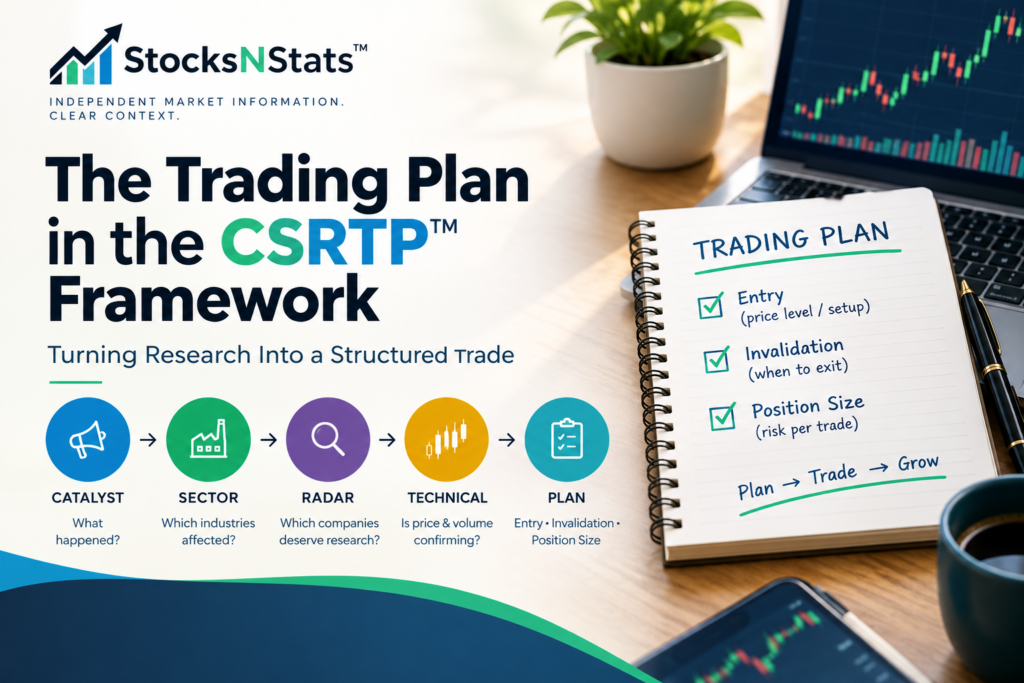
A StocksNStats guide to moving from a stock on the radar to a clearly defined trading plan
Finding a stock with an interesting catalyst is only the beginning.
Through the CSRTPTM Framework, a trader can move systematically from a market event to an affected sector, identify stocks that deserve further research, and then use technical analysis to determine whether the price action supports the underlying thesis.
But even after a stock passes these stages, one important question remains:
What exactly will the trader do if the setup develops?
This is the purpose of P — Plan in the CSRTPTM Framework.
The Trading Plan offers research and technical observations into a set of predefined conditions for a potential trade. It helps the trader decide when to act, how much to risk, when the trade is invalidated, and when to exit before emotions take over.
Where the Trading Plan Fits Into CSRTPTM
The CSRTPTM Framework follows a structured progression:
C — Catalyst
What happened?
↓
S — Sector
Which sectors or industries could be affected?
↓
R — Radar
Which stocks deserve further research?
↓
T — Technical Confirmation
Do price and volume support the trading thesis?
↓
P — Plan
What exactly must happen before the trader considers entering the trade?
The key point is that being on the radar does not mean a stock is ready to trade.
Similarly, identifying a technically interesting setup does not automatically mean that an entry should be taken.
The Trading Plan creates the conditions that must be satisfied before the trader acts.
From “Interesting Stock” to “Planned Trade”
Consider a hypothetical example.
A government announcement has a potential impact on the infrastructure sector. After studying the sector, a trader identifies a company that appears to have strong liquidity, relative strength, and improving price structure.
The stock is added to the radar.
Technical Confirmation
The CSRTP framework can establish:
Sector = Bullish
Stock = Bullish
This tells the trader:
“The technical evidence supports the thesis.”
At this stage, the trader could simply say:
“This stock looks bullish.”
But that is not a trading plan.
A structured plan would indicate that:
Consider the setup only if the stock breaks above the identified resistance with the required confirmation, or consider the setup as per the strategy.
The trader can then define:
- the potential entry condition
- the invalidation level
- the maximum acceptable risk
- the position size
- the exit conditions
- the timeframe
- the conditions under which the trade should be avoided
This changes the trader’s question from:
“Should I buy this stock?”
to:
“What conditions must be satisfied before I consider taking this trade?”
That is a much more disciplined way to approach trading.
1. Define the Entry Condition
The first part of the Trading Plan is to establish what needs to happen before an entry is considered.
The condition should be based on the trader’s strategy and technical setup.
For example:
- Breakout above a defined resistance level
- Pullback to a predefined support area
- Reclaim of an important moving average
- Breakout accompanied by increased volume
- Continuation after a confirmed consolidation
- A specific price-action pattern
The exact condition will vary according to the trader’s strategy.
The important principle is:
Do not enter simply because a stock is on the radar or to establish the technical confirmation. Wait for the predefined condition.
This is particularly important when a stock has already experienced a large move following a news announcement. A strong catalyst does not eliminate the need for price confirmation.
2. Define the Entry Zone
Once the entry condition has been established, the trader can determine the price or price zone at which the setup may become actionable.
For example:
Entry condition: Breakout above ₹500 with confirmation.
The trader may define an appropriate entry zone around the strategy’s trigger rather than simply buying because the stock is moving upward.
This forces the trader to think about price before entering, rather than chasing the stock after a large move.
3. Define Invalidation
One of the most important questions in a trading plan is:
“What would prove that my trade idea is no longer valid?”
This is the invalidation point.
For example, a trader may determine that if the stock falls below a particular support level, the technical structure that justified the trade no longer exists.
That level can then form the basis of the trader’s stop-loss decision.
The important concept is that the invalidation level should come from the trade thesis and market structure, rather than being moved randomly because the trader does not want to accept a loss.
A trade plan should therefore answer:
If the setup fails, where do I admit that the original thesis is no longer valid?
4. Determine the Risk Before the Trade
A trading plan should not begin with:
“How many shares can I buy?”
It should begin with: “How much am I prepared to risk if this trade fails?”
Once the trader has established the acceptable monetary risk and the distance between the potential entry and invalidation level, position size can be calculated.
A simplified example:
Maximum planned risk: ₹2,000
Potential entry: ₹520
Invalidation/stop level: ₹500
Risk per share:
₹520 − ₹500 = ₹20
Potential position size:
₹2,000 ÷ ₹20 = 100 shares
This means the trader’s position size is determined by the planned risk rather than by how strongly they feel about the stock.
Actual position sizing should also take into account factors such as liquidity, volatility, gaps, slippage, and the trader’s overall portfolio exposure.
5. Define the Exit Conditions
A trading plan should not focus only on entry.
Before entering, the trader should also consider:
- Where will profits potentially be taken?
- What price action would justify an early exit?
- What happens if momentum weakens?
- What happens if the original catalyst loses relevance?
- Is there a predefined time-based exit?
- Will the position be managed using trailing stops or another method?
The answer depends on the trader’s strategy.
The purpose is not to predict exactly where the stock will go.
The purpose is to establish how the trader intends to respond to different outcomes.
6. Consider the Reward-to-Risk Relationship
Before executing a trade, the trader can compare the potential reward with the amount being risked.
For example:
Potential risk: ₹20 per share
Potential reward: ₹40 per share
The potential reward-to-risk relationship is: 1:2
This does not mean that the trade will be profitable.
A favorable risk-to-reward relationship does not guarantee a successful trade, and a trade with a favorable setup can still fail.
It simply gives the trader another factor to consider before committing capital.
7. Define the Timeframe
A Trading Plan should also identify the intended timeframe.
For example:
- Intraday
- Short-term swing
- Multi-week swing
- Positional
The timeframe matters because the same stock can have different setups on different timeframes.
A stock may look attractive on a weekly chart but have an unsuitable short-term setup.
8. Wait for the Trigger
This may be the most important discipline within the Trading Plan.
Suppose the trader has established:
Radar → Technical setup → Entry condition
The stock approaches the trigger but does not satisfy it.
The trader waits.
It moves close to the level and then reverses.
The trader still waits.
When the predefined condition occurs, the setup becomes eligible for execution according to the trader’s strategy.
This creates a crucial distinction:
Stock on Radar ≠ Buy
Technical Setup ≠ Buy
Trading Plan ≠ Buy
Triggered Trading Plan → Potential Trade
This distinction can help prevent impulsive entries.
9. Do Not Change the Plan Because of Emotion
Once a position is open, emotions can influence decision-making.
A trader may think:
“I’ll move my stop a little lower.”
Or:
“I’ll add more because the stock has already fallen.”
Or:
“I’ll hold for another few weeks because I don’t want to book a loss.”
These decisions can transform a predefined trading strategy into an emotional reaction.
A Trading Plan is therefore not simply a document created before the trade.
It is a decision framework that helps the trader remain consistent throughout the trade.
When market conditions change, experienced traders may adjust their plans. But any change should be based on a deliberate change in the trade thesis or strategy, not simply on fear, greed, or the desire to avoid a loss.
10. Record the Trade
The final part of the process is documentation.
A trader can record:
| Trading Plan Element | Example |
| Stock | ABC Ltd. |
| Catalyst | Government announcement |
| Sector | Infrastructure |
| Setup | Breakout |
| Entry condition | Break above defined resistance |
| Planned entry | ₹520 |
| Invalidation | ₹500 |
| Risk per share | ₹20 |
| Maximum risk | ₹2,000 |
| Position size | 100 shares |
| Exit condition | Predefined target/technical condition |
| Timeframe | Swing |
| Status | Waiting / Triggered / Active / Closed |
Recording these details creates a history of the trader’s decisions.
Over time, the journal can reveal whether the trader is consistently following the process or repeatedly deviating from it.
A Trading Plan Is Not a Prediction
One of the most important concepts for retail traders to understand is that a Trading Plan is not a prediction of what the stock will do.
It is a framework for dealing with uncertainty.
The trader does not know whether the next trade will be a winner or a loser.
Instead, the trader defines:
If this happens → I will consider entering.
If this happens → my setup is invalidated.
If this happens → I will manage or exit the position.
This approach shifts the focus from predicting the market to managing decisions under uncertainty.
From CSRTPTM to Execution
The complete StocksNStats process can therefore be viewed as:
C — Catalyst
Identify what happened.
↓
S — Sector
Determine which sectors may be affected.
↓
R — Radar
Identify stocks that deserve further research.
↓
T — Technical Confirmation
Study price, volume, trend, relative strength, and market structure.
↓
P — Trading Plan
Define the conditions, risk, and management rules for a potential trade.
↓
Execution
Act only if the predefined conditions are satisfied.
↓
Review
Compare the actual trade with the original plan and identify what can be improved.
The Real purpose of the “P” in CSRTPTM
The purpose of the Trading Plan is not to make trading certain.
It is to make the decision-making process more structured.
A trader cannot control:
- market direction
- news
- unexpected announcements
- volatility
- gaps
- liquidity changes
- the outcome of an individual trade
But a trader can prepare for those possibilities by defining the conditions under which they will act and the conditions under which they will step aside.
Therefore:
CSRTPTM does not end when a stock reaches the radar. The research process continues until the trader has a clearly defined plan for what would make the setup actionable and what would invalidate it.
From Catalyst to Sector.
From Sector to Radar.
From Radar to Technical Confirmation.
From Confirmation to a Trading Plan.
From a Trading Plan to disciplined execution.
That is the role of P — Plan in the StocksNStats CSRTPTM Framework.
Disclaimer
StocksNStats provides independent market information and educational content. The CSRTPTM Framework is intended as a structured research and decision-making framework for educational purposes. A stock appearing on a radar or satisfying a technical condition should not be interpreted as a buy or sell recommendation. Trading involves substantial risk, and individual traders should consider their own objectives, financial circumstances, risk tolerance, and trading strategy before making any investment or trading decision.